
Ngā kōrero hou mō te kaupapa mahi ki Kawau
Kawau project operational updates
Keep up with important operational updates related to the Kawau Island pest eradication activities.
Introduction
The success of this programme, initially and long term, depends on the support and involvement of Kawau Island’s community. Auckland Council is committed to working with you, keeping you up to date and listening to your feedback.
This is your page to keep up with all the important updates on the Kawau Island pest eradication programme and some of the environmental outcomes we hope to celebrate in the future.
Note: As of 20 August 2026 all firearms operations associated with this project have been suspended pending an investigation into a serious accident.
Kawau Operations Update - August 2026
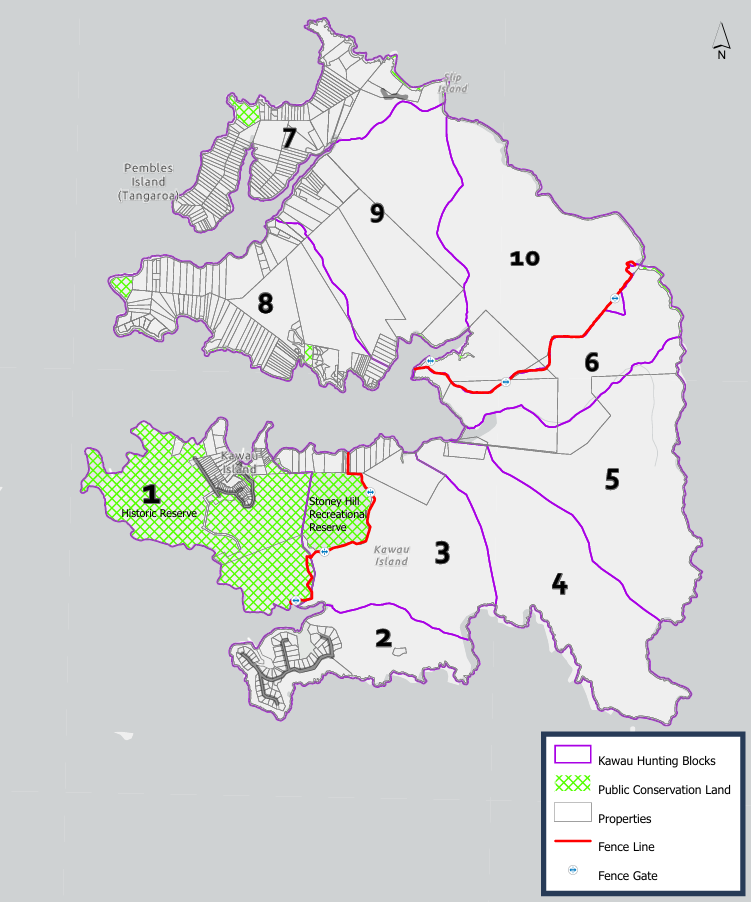
Subject to suitable weather conditions, targeted night-time hunting in Block 2, South Cove residential area (see map below) will take place between the 16th and 23rd August 2026, supported by a thermal imaging drone. Work within residential areas will only occur on properties where landowner permission has been granted. If you see a wallaby or any fresh wallaby sign, please email kawau@islandconservation.org with the date and location. This helps us direct the team to where they are needed most. Wallaby identification guide available at this link HERE.
WHAT
- Night hunting with suppressed firearms and drone-assisted support
- Strict safety protocols in place
WHEN
- August 16th - August 23rd, 2026
- From 7pm
- Weather dependent
WHERE
- Block 2: South Cove residential area
- Where landowner permissions have already been granted
Toxin Operation Update, April 1st
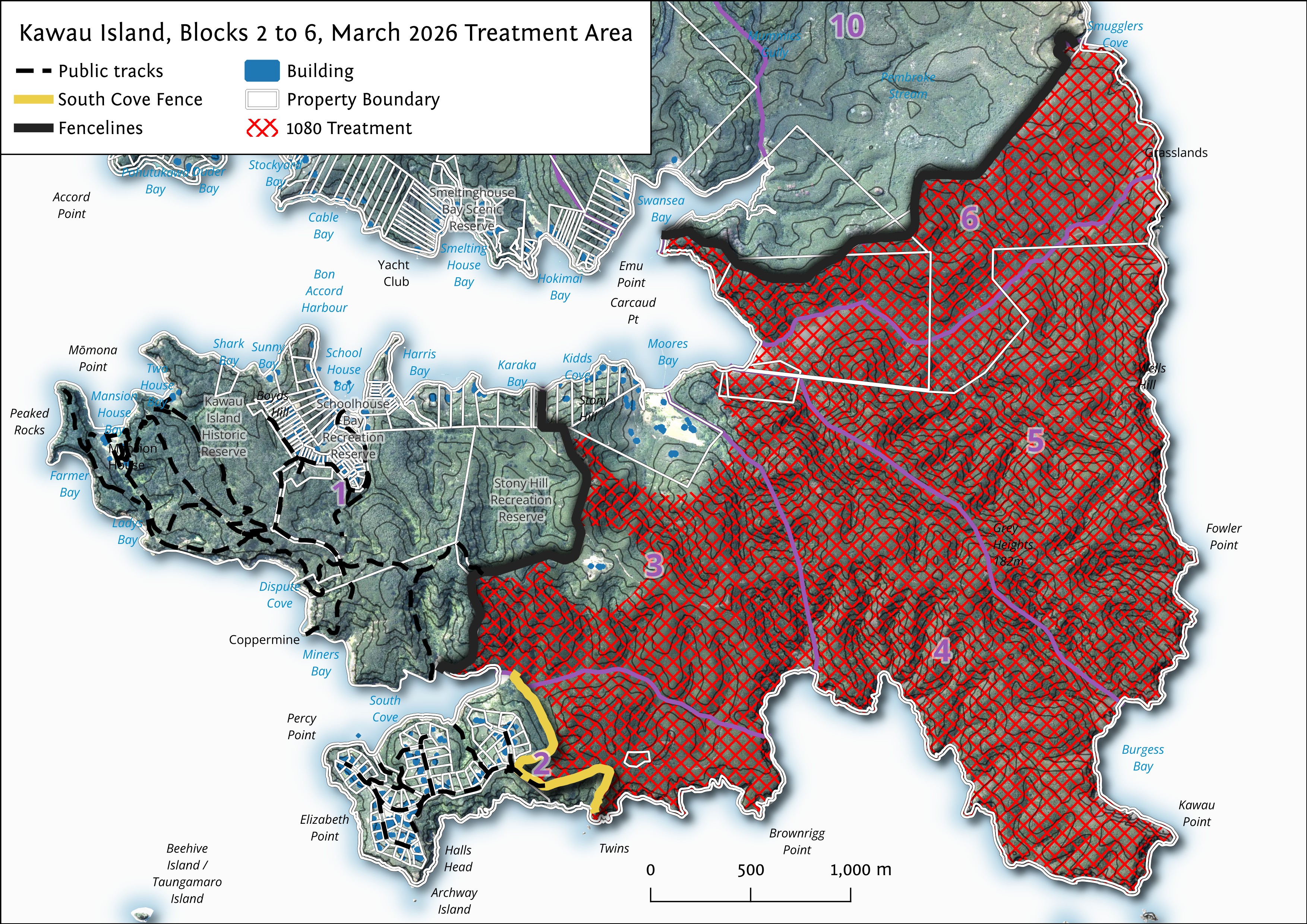
The ground base 1080 operation has concluded. The six‑month cautionary period following the toxin operation has now begun and it’s important to take extra care to ensure the safety of your pets. All uneaten cut foliage treated with 1080 gel has been removed. However, some residual 1080 cereal pellets remain on the ground and continue to break down naturally, helped by the recent wet weather. While carcasses are decomposing quickly, they continue to pose the highest risk to dogs during the cautionary period. If you are bringing a dog or any other pet to the island, ensure they are kept on a lead or contained at all times.
Visitors with dogs:
- Keep dogs on a lead at all times
- Do not let them scavenge carcasses
- Stay on tracks and roads only
- Avoid the treatment area
- Continue to observe all warning signs
Refer to the Protecting Your Dog factsheet for more guidance, Should you have any concerns about potential toxin exposure or require urgent advice, please contact:
Warkworth Vets: 09 425 9260, 27 Hudson Road, Warkworth.
Note that:
- the toxin application will support the ongoing hunting effort to remove wallabies and possums where numbers are high. This has been revealed by regular camera and drone monitoring in the southern blocks.
- the treatment area is on private property and gates to the property will be locked. Please refer to map below.
- baits will be placed a minimum of 20 metres from private tracks and roads.
- warning signage will be in place at wharves, main entry points to the treatment area and at treated foliage sites.
- neighbouring properties will be notified ahead of toxic bait application and once foliage bait has been removed. Cereal bait will degrade naturally in the environment.
- Public Health conditions, including exclusion zones for block one and setbacks from residential areas, will apply. Monitoring of ground-based domestic water supplies within or downstream of treatment areas will also take place.
- carcasses will be removed where practical. A caution period of several months will follow while carcasses naturally break down.
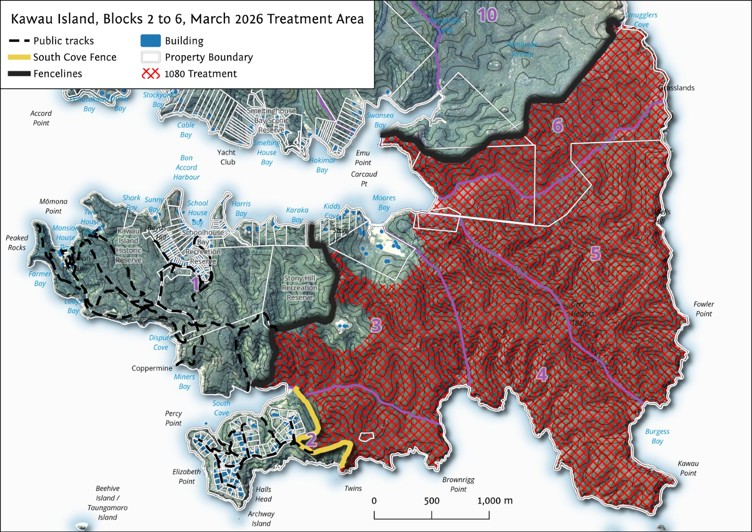
Map of Kawau Island showing the ground-based 1080 treatment area.
Download map (PDF - 2.51MB)
Further information
Visit the Kawau project news and key safety information webpage. Also refer to the Kawau Island eradication project factsheet for landowners and residents (PDF 1.85MB) and the dog protection factsheet (PDF 1.02MB) for further information.
Questions or concerns
Phone 09 301 0101. Email kawauislandproject@aucklandcouncil.govt.nz
Previous updates
Check out previous updates - May to Nov 2025 (PDF 156KB).